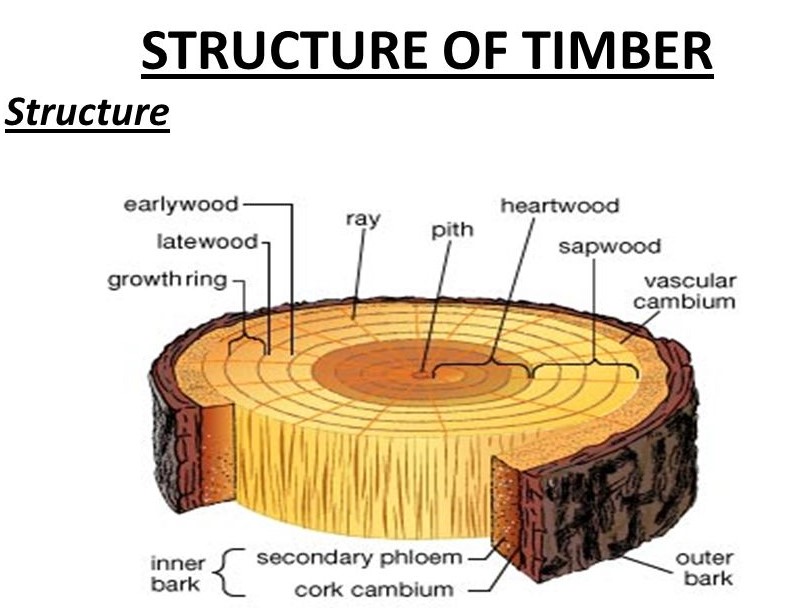
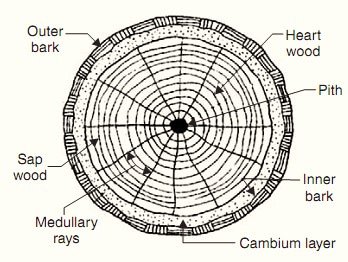
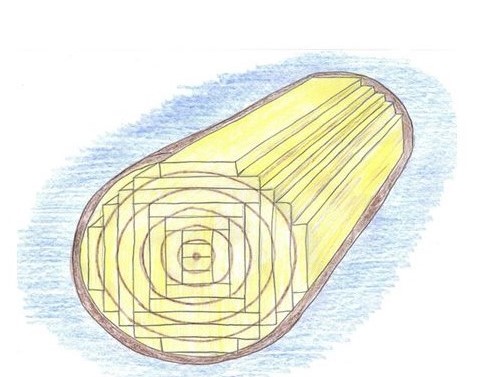
1)Pith : Inner most part having soft tissues near about the center of log of a timber.
2) Heart Wood : Inner Part of Log of a tree surrounding the pith is called Heart.
3) Sap Wood : Outer Part of log of a tree surrounding heard wood & upto the bark which contains living cells Is called Sapwood.
4) Cambium Layer : Layer of liquid material deposited below the bark & outside the sap wood in the log called Cambium Layer.
STRUCTURE OF TIMBER Structure
5) Inner Bark or Bast : The inner skin surrounding The Cambium Layer. This skin feed & covers the Cambium Layer.
6) Outer bark : The covering outside the log of a tree.
7) Annual Ring : Concentric innumerable rings in the log of a timber,Indicating its growth are called Annual Rings.
8) Medullary Rays : Horizontal thin fibrous tissues which extended radially from the cambium layer towards the core or from the pith towards the bark.
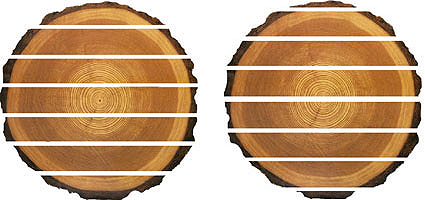
Types / Sawing of Timber :
Ordinary or Slab Sawing
Tangential Sawing
Ordinary or Slab Sawing : Most economical method As the wastage of timer & cost of sawing minimum.Cuts are made into the log of wood according to the required thickness, not necessarily tangential to the annual rings.
Tangential Sawing : The board & planks are sawn out of wood tangentially to the annual rings. Economical due to less wastage &involves less Labor do not suit for heavy works as for flooring.
Quarter Sawing : Log cut into four quarters. These quarters have their flat faces essentially radial.Cuttings the annual rings at angles not less than 45Degree. It requires more labour & involve more Wastage.
Radial or Rift Sawing : Log cut out of quarter logs Parallel to the medullary rays & perpendicular to the annual rings. Uneconomical method. It produces timer with end grains which are sometimes known as “Silver Grains” by sawing parallel to the medullary rays.Used for High Class decoration & joinery work.
Combination Sawing : Log is converted by the Combination of two or three methods.Advantages of Ordinary & Radial Sawing.
Common Markets Forms & Sizes of Timber :
A) Log : Stem or trunk of a tree which is felled.
Log of Timber
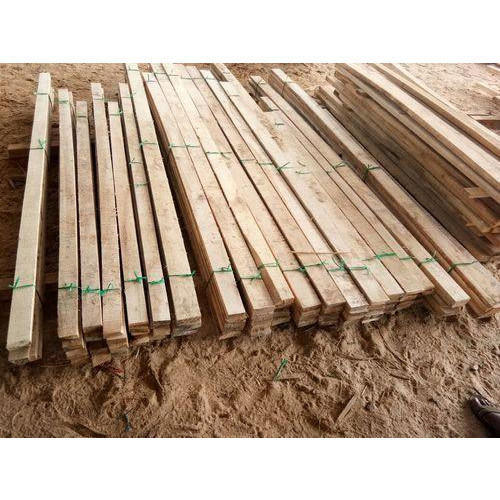
B) Baulk : A piece of sawn timber, cross sectional Dimension of 50mm in one direction & 200mm in other.
C) Bole : The
main stem of a tree
D) Bolt : A
Short log 1.25m or less in length.
E) Billet : Short length of a thin stem or branch wood.
F) Batten : Piece of sawn timber, the cross sectional dimension of which dn’t exceed 50mm.
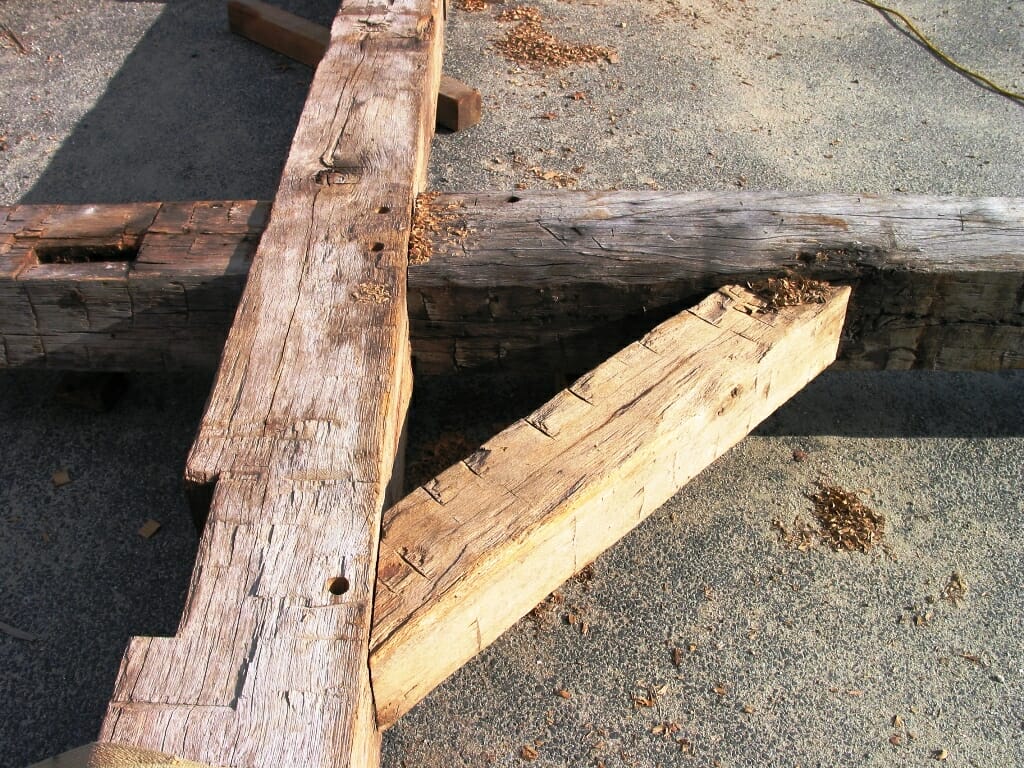
Timber derived from Timberian which mean to build.The wood used for building or other engineering purpose is called timber.
It is a first construction material used by a man since pre-historic ages.
Timer is a natural material. Trees provide shelter from sun and the rain.
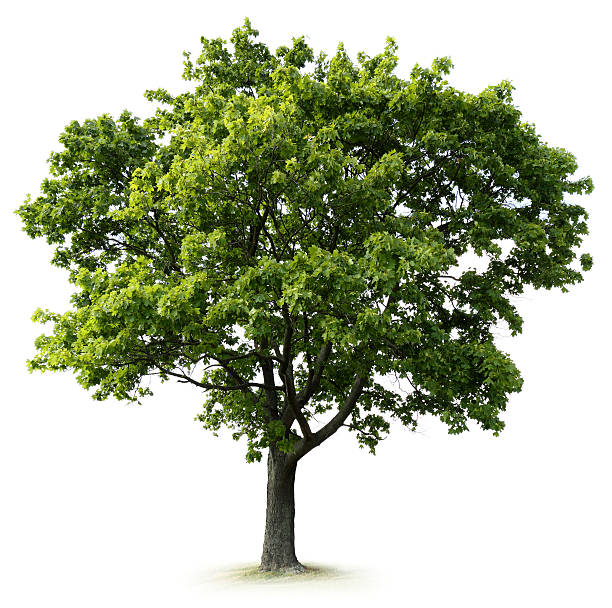
Tree: Maple Tree
Trees conserves soil moisture. It precipitate rainfall & lower temperature .A single Tree can cool the summer heat better than 20 Air conditioners.
It prevents depletion of the ozone layer of the atmosphere. It prevents soil erosion.
Trees produces oxygen and purifies the air.
Timber :
Timber
Timber obtained from trunk of a tree. There are many varieties of timber available all over the world.
Advantages :
Timber is strong than any other material. Timber can be easily worked to any size & shape. It can be jointed to required form.
Timber can used for furniture & decoration fittings. Structural connections can be easily made in timber. Timer are light in weight, quite durable.
Its resale value is good. Its non conductors of heat & sound.
Timber uses in construction
Classifications of Timber :
1)Exogenous Trees
2)Endogenous Trees
Exogenous Tress :
Trees which grow outwards and increase in bulk by the formation of successive annual rings are known as exogenous trees.
Exogenous Trees Structure
Timber which is used for building engineering works,Is Mostly obtained from exogenous trees. Examples : Deodar, Kail, Sal, Teak, Shishum, Chir etc .
Exogenous trees are further divided into following two types:-
1)Conifers or Evergreen Trees
2)Deciduous or Broad – Leaf Trees
Conifers or Evergreen Trees : Soft Wood
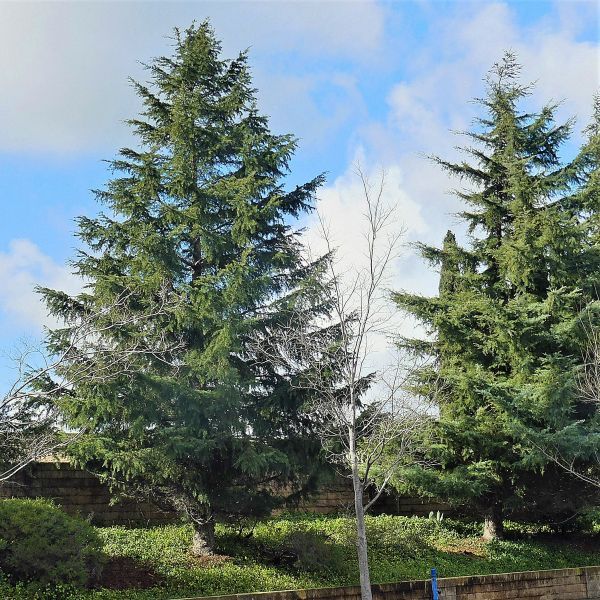
Trees which remain evergreen & bear fruits.These trees usually yield soft wood & show distinct annual rings. They are light in color & weight.
They can easily split & are resinous. They are comparatively weak in strength. Example :Pine, Deodar, kail, Chir,walnut etc
Deodar – Conifers Tree
Deciduous or Broad Leaf Trees : Hard Wood
Trees which shed their leaves in the autumn &put on new leaves in the spring season are known as deciduous or broad leaf trees.
These trees usually yield hard wood & dark in color, Hard, close grained and strong.They are useful for important engineering works. Example :Sal, Teak, Shishum, Babul, Ash, Mahogany etc.
Deciduous or Broad Leaf Trees
Endogenous Trees :
Endogenous trees which grow end wards in a longitudinal fibrous mass are known as endogenous trees.
These trees are too flexible & aren’t suitable for engineering works.Example : Canes, Bamboos , palms etc
Accent walls aren’t just a trendy statement, An accent wall designed in a room,
whether a bedroom or a living space, It help you focus attention to certain
areas of the room. they’re a cost-effective way to spice
up your home. It may make the room
feel bigger, or even make it feel cozier and more inviting.
First decide on the right wall. The general
rule of thumb rule , use the wall that first grabs your attention when you
enter the room.
Painting Bold & Texture Color
– Selecting the
right color that might be the most difficult step. Thumb
Rule for color ratio 60-30-10 rule when picking out a color: 60%
of the room should be your dominant color, 30% should be a secondary
color, and 10% should be an accent color. With that in mind, you’ll
want to find a very minor color in your current color scheme–likely something
bold or bright that will differ dramatically from the other colors in the
room–and work with that.
If you’re wary of
committing to a permanent accent wall (although I blink at the idea of paint’s
being considered “permanent”), remember than an accent wall can actually be the
same form and color as the rest of the walls in your home; it’s what you DO
with the wall that makes it stand out.
Gallery Wall to create a Focal Point – A wall of framed photographs, making that wall stand out with a distinct
color or design can also bring more attention to those décor elements.
A large mirror, piece of art, or many smaller photographs grouped together on
an accent wall can immediately bring attention to them. A perfect way to
display your love for the family with a gallery wall. You can choose any design
or even make a family tree to display the beautiful memories you’ve made.
Wall paper –
By using of wall
paper you save lot of time for application . It hardly 5 to 7 hour job depend
upon the area how much big /small. In these day there are so many color design,
3D, 5D,Floora print, Plain, Texture etc wall paper available in market.
Lighting – Giving Led Lighting
Effect for your accent wall which enhance more beauty of accent wall.
Lighting should be well designed. Lighting should Not be too much. You can use
warm light for relaxing the ambiance.
Laminate – You can complement
the beautiful look of your floor by making a statement laminate flooring on
your walls. It look and feel of real hardwood. This is a creative way to use it on wall and the same time
it’s a budget material also and easy to install. Laminate
Graffiti
– Graffiti looks
stunning on a feature wall or sprayed to highlight interesting detail. Graffiti can make
impact in all kinds of interior spaces such as cafeterias, hotel lobbies,
bedrooms, kitchens, living areas. Graffiti can be applied on almost any
surface and material. Thanks to these properties, Graffiti can be a fun
DIY project, I would like to mention that graffiti paints are durable,
strong and do not require priming before application. The
painting is resistant to fading and mechanical damage.
It is environmentally friendly and doesn’t emit toxic substances in the air. The painted surface is very easy to maintain and is possible to wash with soap and brush. Graffiti creates great possibilities in interior design: from hiding architectural flaws, visually changing dimensions of the room to decorating walls that look too “empty”. Airflow easily transfers the ink in hard to reach places.
Graffiti mural wallpaper for teenagers
Hard-Working Chalkboard Accent Wall – The chalkboard-iness of this wall is tastefully downplayed by letting it double as an art gallery wall. For those with kids, scribbling on the wall may be a nightmare! But if you have a chalkboard painted wall then it can double as a canvas for you and your kid!
Art Display – You can also hang artefacts like made of metal, plastic or even create a design by arranging them symmetrically. You can find accent pieces in any store and they are easy to replace as well. If you’re not keen on spending loads of money on an accent wall then you can always create something new. Use old cutlery or paint a plastic paper plate and hang them on the walls.
Geometric Pattern – This season has turned the spotlight on interior design’smain ingredient – geometric. Geometrical patterns combine to create a look that is pleasing to the eye. This trend is all about balancing colors, prints, and textures as they seamlessly enhance each other without being too overwhelming.
Metal – Punched metal, also known as perforated metal, A unique look to accent a full wall or a half wall in a room is to use the panel as an accent over an existing wall. Choosing stainless or aluminum punched metal sheets will give a more modern look, while a brass or copper panel will give more of a traditional or antique look.
The shape of the perforations themselves and the pattern or irregular placement of the perforations will also contribute to the style and impression of the panel in the room.
Wall Tile work – A tile accent wall use them frequently in bathrooms, bars, and even in bedrooms and other spaces. There are some really amazing tiles that will wow you and create huge impacts in a home.
3 D Panel – 3D wall panels are ideal wall covering products that can be used in interior and exterior decoration. They are great solutions to ugly, stubborn problematic wall, Get wall design ideas and inspirations for your accent wall project.
3D wall panels give an extra dimension to your walls and compliment just about any room in the house. 3D Wall Panels are an exciting range of decorative, textured wall panels with patterns carved into their surface. A feature wall in 3D wall panels creates a huge impact, lending an architectural feel to the room at relatively little cost.
Mural – This fantastic idea, other than to choose a mural scene that speaks to you. This accent wall idea is wonderfully simple and full of charm and character.
Fabric Wall
– Fabric can be used
in a way similar to wallpaper to create an unforgettable accent wall. Bonus: In
a Bedroom, an accent wall can even double as the headboard.
Mirror – Mirrors don’t just look dashing but also make the room feel spacious and airy. Add a mirror or a collection of them to pull off a glamorous look.
Decorating your home with mirrors is a great way to liven up a space and add a touch of visual excitement. With so many styles, shapes and colors. A mixture of circular, square and other shaped mirrors will add an intriguing element to your space while making it appear larger at the same time.
Shelf – If your favorite feature in a room is the beautiful built-ins, emphasize this by transforming the shelves into an accent wall. Paint out the back wall, but leave the shelves as they are. The use of monochromatic pieces on said shelves will go a long way to emphasize the accent wall itself.
Natural Stone – To bring more of the outdoors indoors, there’s nothing like the natural beauty of natural stone. Stone accent walls can add more than just interest to a room; they add depth, dimension and design! So, if you have a room that could use a boost, consider using natural stone as a way to get that dream job done.
POP Molding – Putting molding walls got a bad reputation when so many builders decided to put a single piece of molding around the room called a chair rail (literally one of my least favorite things). However, molding on a wall can look super sophisticated. From the traditional picture frame molding to the more contemporary box molding
Wood – When it comes to statement home improvements, a decorative wood plank wall contributes a polished look with timeless appeal. Providing warmth, texture and rustic-sophistication to any room I tend to lean more towards the modern use of wood as an accent wall, but for clients who love that “farmhouse” style, you can also use reclaimed wood. Make the living room the focal point of your home with a breathtaking wood wall.
A great way to create a warm and inviting space, a feature wood wall is the perfect way to easily accentuate any living space. Add a decorative plank wall to any bedroom to unleash tranquil vibes. Whether you decide to plank a full accent wall or create a chair rail, your bedroom becomes your personal haven with the presence of a plank wall. Providing a warm and cozy feel, simply peel, stick and relax.
There are plenty of wall accents that give your home an instant uplift but all you need to do is think creatively.
When
setting up your retail store, there are a lot of questions in your mind : how
to best display your products, how the general layout of your store should look, and
much more.
Retail Lighting for Product Display & create a ambiance
What about lighting design? While lighting may be an afterthought for many retailers who are just starting out, retail lighting can provide much more than simple ambiance. This basic utility can also impact your sales and customer experience.
In the right light, at the
right time, everything is extraordinary.” —Aaron Rose, photographer
Retail lighting varies depending on the type
of store, product/ brand goals, and merchandise being displayed.
Lighting can contribute to a unique shopping experience that keeps customers coming back. Some retailers are installing consistent lighting as an extension of their brand, Some use lighting to create multiple dynamic spaces to make their stores more of a destination.
For example, jewelry stores often
require very small point sources with relatively high color temperatures
to make gemstones sparkle while favoring lower color temperature sources
for areas displaying gold. It’s all about using the
best lighting solution to create a unique store experience that attracts
shoppers and keeps them in store. – for example, fashion, car showrooms,
electronics stores and supermarkets.
Big-box stores typically
prioritize energy efficiency, maintenance, uniformity of light levels, and low
installed cost.
Boutique
applications typically
prioritize color quality, visual comfort and setting a desired look. Both are
typically concerned with using focal lighting to accent and promote key
merchandise.
Warm, soft lighting can make people feel relaxed and comfortable, while brighter lighting helps customers see products more clearly.
Shopping is primarily a heads-up visual
activity, achieving good vertical light levels (typically 6 ft.
above the finished floor) is often more important than horizontal light
levels (typically 3 ft. above the finished floor).
Lighting depending on store design
and merchandise displays, once a general light level is established, the accent/feature
display and vertical/perimeter lighting systems can be determined.
Accent lighting to
achieve the most dramatic and visually interesting displays, a contrast
of five to 10 times the ambient light level is most effective. While all this
is more easily taken care of in new construction projects, we find a lot of
accent lighting in existing stores has become marginalized over the years.
LED lighting is becoming increasingly popular in retail spaces in both new construction and upgrades. “LED lighting has become the proven path to better light for retail applications
LED sources allow retailers to dramatically lower the cost of ownership through high system efficacy, long life and high color rendering.
Integrate/Decorate – LED
lighting more easily integrates into store fixtures and architecture, making
the lighting disappear. Alternately, the lighting can stand out as a decorative
element
Volumetric Lighting – Selecting luminaries that throw light on walls and ceilings can make the retail space appear larger and more inviting. “This is a particularly important trend in big-box retail where a lack of light on the high ceilings often creates a cavelike, gloomy effect, while glare can make it difficult to see products on the top shelf”.
Finding Your Fixtures – One way to create an atmosphere with your lighting strategy is through the light fixtures. Break up your space with a mixture of light fixtures in different parts of your store, like the entrance versus the changing rooms.
Choose a Temperature – you can create an inviting atmosphere in your store is by using a warm or cool temperature of lighting — there are benefits to both color schemes. Lux states that “Cool color temperatures such as cool white make areas appear more spacious whereas warm color temperatures create an impression of smallness and familiarity.”
So, if you have a small store that you’re trying to make feel larger, consider using cool lighting.
Vastu Shastra is a science that deals with the construction and architecture. . It helps in maintaining a positive flow of energy in the constructed area and brings good luck and prosperity in commercial/office space.
An Meeting area for the office
where reasons and logic of science are used. Rules of Vastu Shashtra are observed by balancing the five elements of environment – ‘Panchabhutas’ (Water, Fire, Earth, Air, and Space). These rules define the directions and state what to place where and what should be avoided for the growth and prosperity of business.
‘Panchabhutas’ (Water, Fire, Earth, Air, and Space)
It is important to build an office /Commercial as per the guidelines of Vastu. If you are planning to purchase or renovate a commercial space for your business, here are few tips which you should keep in mind for help in selecting the best Plot as per vastu directions & shape, layout, space arrangement, principles of design, entrance, Lockers, furniture etc.
Plot Shape & Direction– Plot should be
Rectangular & Shermukhi plots. A rectangular plot of
side ratios between 1:1 to 1:2 are best suited. but if it is not as per Vastu
guideline, then the irregularity can be treated with various Vastu remedies.
According to the Vastu Shastra, the office/Commercial should always be North. It is believed that North direction brings a lot of positivity and good fortune for business and is considered as an auspicious direction for all office space.
Entrance –An office/commercial should be in the North, North-East or
North-West facing direction. These directions are considered to bring
good fortune and positivity for business & the most auspicious
directions for office spaces as well as commercial space. It makes employees feel
fresh and very productive.
North Direction( Kuber (the lord of wealth) direction), thus it
profits you in financial terms as well.
East Direction – East direction the direction of a Service industry related office. East is a sunrise direction and it gives great growth to the work.
Reception
/Welcome Area –
First impression on the visitors. The reception area should be very relaxing and
one that gives positive vibes.
Welcome room should be located in the East Direction or the North-EastCorner of the Plot/space. It is advisable to put a photo or idol of God in the reception area, and the Reception desk should be placed facing North-east direction. Decorating flowers and offering sweets in any way creates a positive aura and good relationship value with the visitors.
innovative table designs Wonderfully The fice Furniture Blog at ficeAnything Furniture
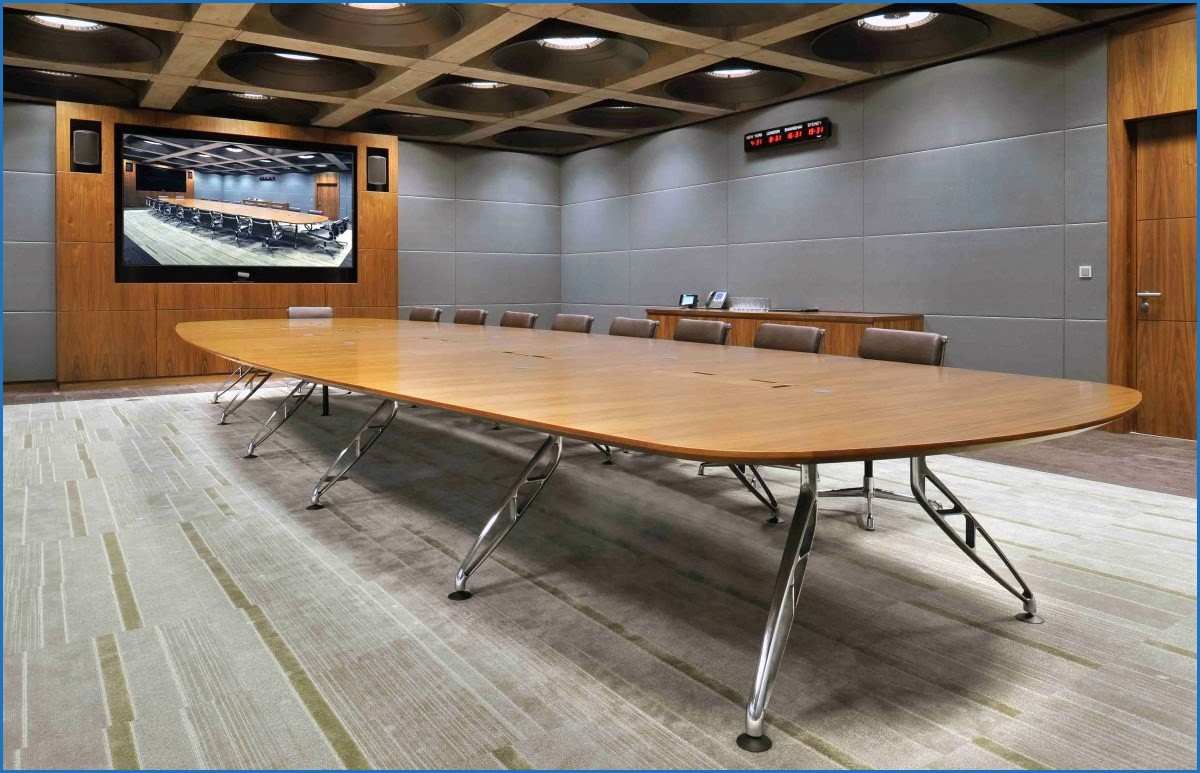
Conference Room – should be placed in the north-west direction. These zones can spur on projects, bring you good and reliable clients and ensure that sales and dispatch go well. For gaining useful connections, keep the North-West zone healthy. This will generate support and help from investors and lenders.
Finance department should be in the north and east zone and employees dealing with bank and cash transaction should sit facingeast and north direction. All the financial records should be kept in central north or southwest of the cabinet.
Business Head – Business head should occupy a cabin in the western part of the office & facing towards East or North direction. . Also, make sure the temple or pictures of any Idol or God must not be placed at the back side of the owner’s seat.
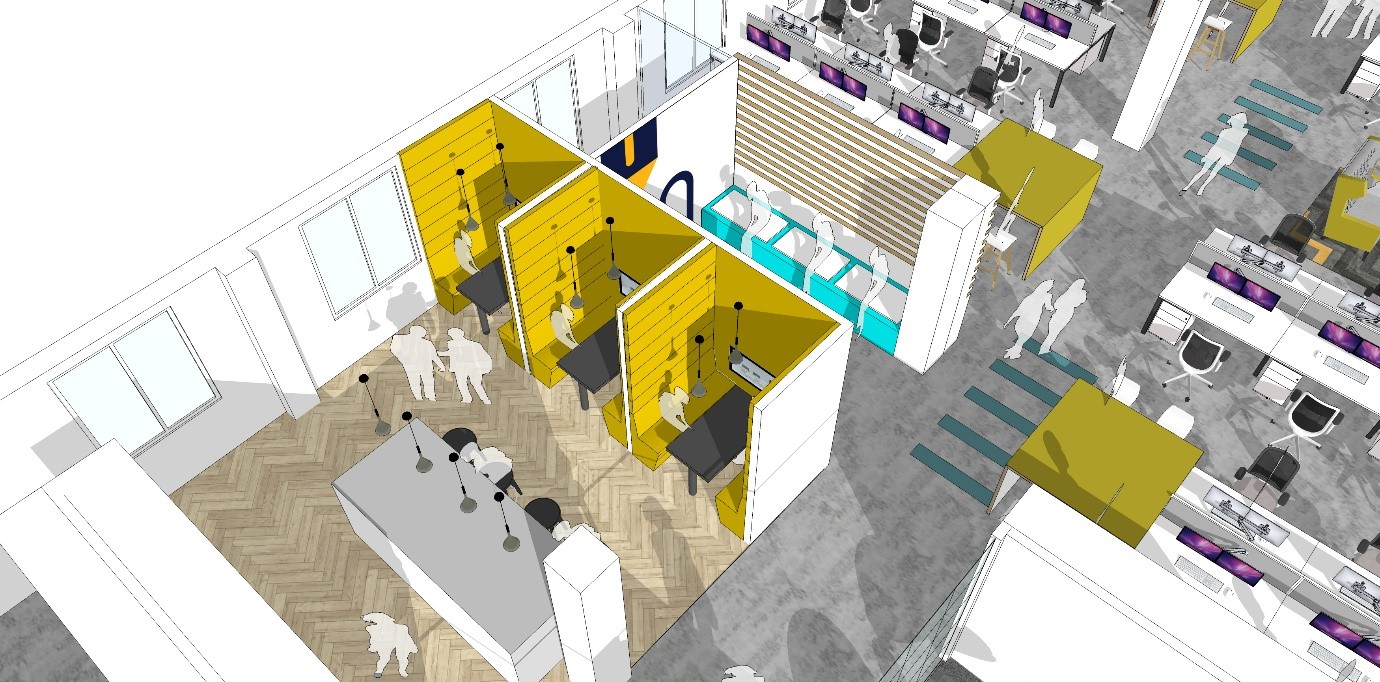
Seating Arrangement – The seating arrangement in the office must be planned according to Vastu tips for office. For the Manager, Director and Executives of the office, the seating arrangement must be in the Southwest, South or West zone of the office as per commercial Vastu. The seating arrangement must be facing towards North or East while working in the office. Working while facing towards North or East direction increases the productivity of the employee. Plot Shape & Direction– Plot should be Rectangular & Shermukhi plots. A rectangular plot of side ratios between 1:1 to 1:2 are best suited. but if it is not as per Vastu guideline, then the irregularity can be treated with various Vastu remedies. According to the Vastu Shastra, the office/Commercial should always be North. It is believed that North direction brings a lot of positivity and good fortune for business and is considered as an auspicious direction for all office space.
Storage Rooms – should be in the
south west. Waste material, too, can be stored in this direction.
Washroom
– Washroom should
be constructed in the West or North-West direction. Also, make sure the
washroom is not in North-East, South-East or East direction.
Pantry –
Pantry
is very important in an office.
Pantry should be located in
the South-East direction; it is known to be the ideal direction & never
construct a pantry in North direction.
One of the most important things is one should keep in mind while eating in office is that there should be a separate place for eating. It should not be painted in pink or red color.
Staircase – Best direction for Staircase in South or South-West. Make sure you dont construct one in the center of the office as it may lead to financial loses to the owner. And staircases must be painted in subtle light colors.
Colors – As per Vastu for Office/Commercial the décor and colors of the office should be bright and vibrant. Bright colors are known to spread positivity in each corner and it reflects light to all the directions.Using colors like blue, white and grey makes the aura cheerful. White, creams and tone of yellows can be used for Southeast, East, Northeast and Northwest walls.
Did you know that color psychology can affect the way you think and feel ?
Example the bright blue in a clear morning sky makes us feel alive and free; the deep purples and reds in the flowers that bloom in Spring evoke emotions of warmth, life and energy. It’s true! That why you have to more careful when you choose the colors for your room.
Decide what mood you want to convey your guest throughout
your home. Relaxed, dramatic, romantic, etc. This will help guide you in terms
of color saturation (how intense/bright the color is) and how much of it you
use.
Choose 2 -3 of your absolute favorite colors & than choose complementary color. Create a mood board for a better picture. After That Go for Paint work , Upholstery & Furniture , soft furnishing (curtain, cushion , Rug , bed sheet etc.) , Lighting & Last choose the Statement Piece for complete look of the Room.
Types of Color Schemes –
Monochromatic – A monochromatic color scheme is one where different shades of one color are used. For example using different shades of blue, ranging from pale to navy.
Analogous – An analogous color scheme is one where you use colors that fall next to each other on the color wheel. For example, using green and blue. The analogous color scheme refers to using three colors in a row on the color wheel. Typically, two colors will be either primary colors with the third shade being a mix of the two and a secondary color. For example, you could choose red, orange, and yellow or red, purple, and blue. The key to using this color scheme successfully is proportion. Again, the 60-30-10 Rule comes into play.
Color Wheel
Complementary – Complementary colors are positioned opposite each other on the color wheel. Every primary color has a complement that creates a vibrant contrast. If you like the idea of a complimentary color scheme, but are afraid it may be a little too bold for your tastes, split complimentary is a safer choice. you would first choose your base shade. Then, instead of choosing the color directly opposite of your base, you chose the two shades on either side of the opposite color.
Complementary Colors
Those two shades will provide a much needed sense of balance to the room.
Warm – Red, orange, yellow and the colors in which they show dominance (or the colors with these as undertones).
Warm Color
Cool – Blue, green, violet and the colors in which they show dominance ( or colors with these as their undertones).
Accent colors – These are the one which are used to create the ‘pop of color’, these have to be intense and bright with an opposite undertone. Remember, with the accent color ‘less is more’, use it as minimum as possible, instead of creating small spots of this a big, bright focal point shall be ideal. This is totally an optional color, but adding this will create a nice break and thrill in your décor.














 Tanya Decor